
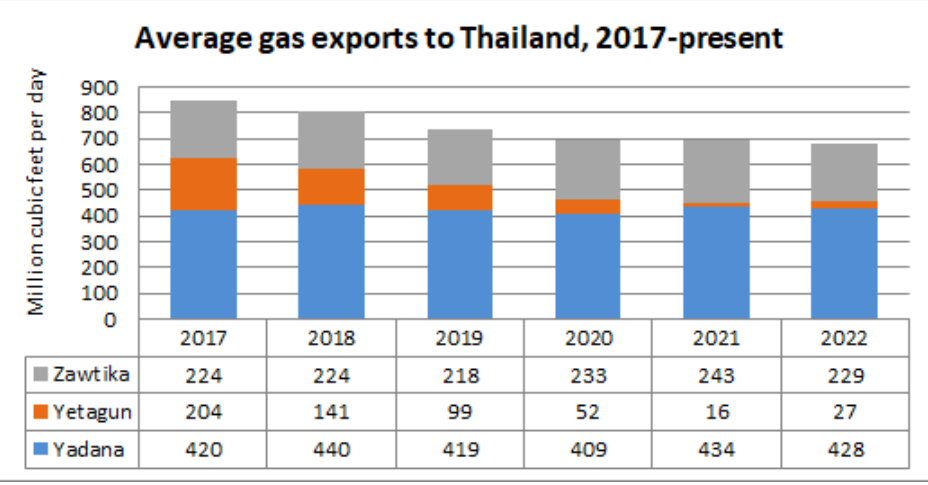
Gas exports to Thailand were down 2% year-on-year in 2022 to an average of 684 million cubic feet per day (mmcfd), according to figures released by the Thai energy ministry.
Volumes exported last year were around 693 mmcfd.
Yadana exported an average of 428 mmcfd of gas in 2022, down 2% from 434 mmcfd in 2021.
Exports from Zawtika were down around 6% year-on-year in 2022 at 229 mmcfd, compared to 243 mmcfd the previous year.
On the other hand, average exports from Yetagun rose 69% year-on-year from 16 mmcfd in 2021 to 27 mmcfd in 2022.
The average export volumes for each offshore area in 2021 and 2022 are as below:
|
Yadana |
Yetagun |
Zawtika |
Total |
|
|
12M 2022 |
428 |
27 |
229 |
684 |
|
12M 2021 |
434 |
16 |
243 |
693 |
Source: Thai energy ministry; in million cubic feet per day
In recent years, average production at the long-producing Yetagun field had begun to decline rapidly, dropping from 141 mmcfd in 2018 to only 52 mmcfd in 2019.
Throughout 2021 and 2022, the project faced several disruptions due to technical challenges as well as a change in ownership.
In late April 2022, all three foreign partners in the area announced their plans to withdraw from the project. Production at Yetagun averaged only 10 mmcfd that month, and it was halted in May.
The Myanmar subsidiary of Thailand’s Northern Gulf Petroleum took over as operator of the field after winning a less than competitive tender. Handover reportedly began around the end of May, and exports from the field resumed in July, averaging 3 mmcfd for the month.
In August, exports from Yetagun shot up to 38 mmcfd, and in September they have remained around this level since.
Myanmar’s gas exports to Thailand are expected to continue declining in the coming years, due to the anticipated slowdown in production from Yadana and Yetagun.
While Yadana is currently Myanmar’s highest-producing offshore area, its output is expected to slow starting around the middle of the decade.
Since around 80% of production is exported to Thailand and China, a drop in exports will mainly be reflected as a drop in earnings.
Prior to the military takeover, the then-Ministry of Planning, Finance and Industry projected that by FY2024/25, Myanmar’s cumulative annual production would decline to around 451 billion cubic feet (bcf), down 32% from 662 bcf in FY2018/19.
Source: Thai energy ministry
About Yadana, Yetagun and Zawtika
Yadana offshore area is composed of the M-5 and M-6 offshore blocks. As of 20 July 2022, it is operated by Thailand’s PTTEP (37.1%), with Chevron (41.1%) and the Myanma Oil and Gas Enterprise (MOGE) (21.8%) also holding stakes.
Chevron in February 2023 reported that it would sell its stake in the project to Canadian independent MTI Energy. However, it is unknown when the transaction will be complete.
Yetagun offshore area encompasses the M-12 and M-14 blocks. As of summer 2022, the project is a JV between MOGE and Northern Gulf Petroleum’s subsidiary Gulf Petroleum Myanmar, with MOGE holding a minority stake.
The M-9 offshore block and part of the M-11 block comprise the Zawtika offshore area. PTTEP operates the area and holds an 80% stake in M-9, with MOGE holding the other 20%.